If you have recently moved to Lithuania or find yourself here in the first days of November, you will notice how the rhythm of the country changes. Rows of candles and chrysanthemums appear in stores, cities grow quiet, and roads toward cemeteries fill with cars.
These days in Lithuania are quiet, and in the evenings they are bright with candles. The main event of early November is Vėlinės, the day of remembrance of the dead. In it, a Christian custom is interwoven with the old Lithuanian holiday Ilgės.
What is Vėlinės and when is it celebrated
On the calendar, these are two non-working days in a row:
- 1 November — Visų Šventųjų diena (All Saints' Day). A Catholic holiday.
- 2 November — Vėlinės (Day of Remembrance of the Deceased). A day of remembrance for deceased relatives and ancestors.
There is no clear boundary between these days: cemeteries are most often visited on 1 November, and candles are lit in the evening of both the 1st and the 2nd.
The word Vėlinės is connected with vėlė — that is what the soul of the deceased is called in Lithuanian tradition. According to folk beliefs, vėlė separates from the body after death but does not disappear: it remains near the home and protects the family and the harvest.
How it was celebrated in the past: Ilgės
Vėlinės in Lithuania formed when the Christian custom intertwined with the ancient holiday Ilgės. Ilgės was celebrated not for one day but for a whole period after the harvest. The following customs have come down from it:
- A meal for the souls. According to chronicles, treats were prepared for the souls in bathhouses or at the cemetery: it was believed that they came to share the meal with the living.
- Dinner at the family grave. In villages, on the day of Vėlinės, people gathered at the cemetery, prayed, sat by the family grave, and ate, inviting the poor. In some places in Eastern Lithuania, food was placed on the grave on the evening of 1 November and left overnight, and it was distributed to the needy only on 2 November. In Dzūkija and Eastern Aukštaitija, food was left on graves in some places until the beginning of the 20th century.
- A guest in the house. An unfamiliar traveler who came into the house on the night of Vėlinės was welcomed warmly: it was believed that the vėlės might have sent them.
- Bonfires. Village communities lit large communal bonfires near cemeteries. The fire showed the souls the way and warmed them in the autumn cold.
From the mid-19th century, the holiday drew closer to church services: priests called people to worship, asked them to go only to their own parish cemetery, and not to bring food to graves. And candles in cemeteries are a relatively new custom: it became established from the beginning of the 20th century.
What it looks like today: a sea of candles and silence
Today Vėlinės is a quiet day of remembrance spent with family.
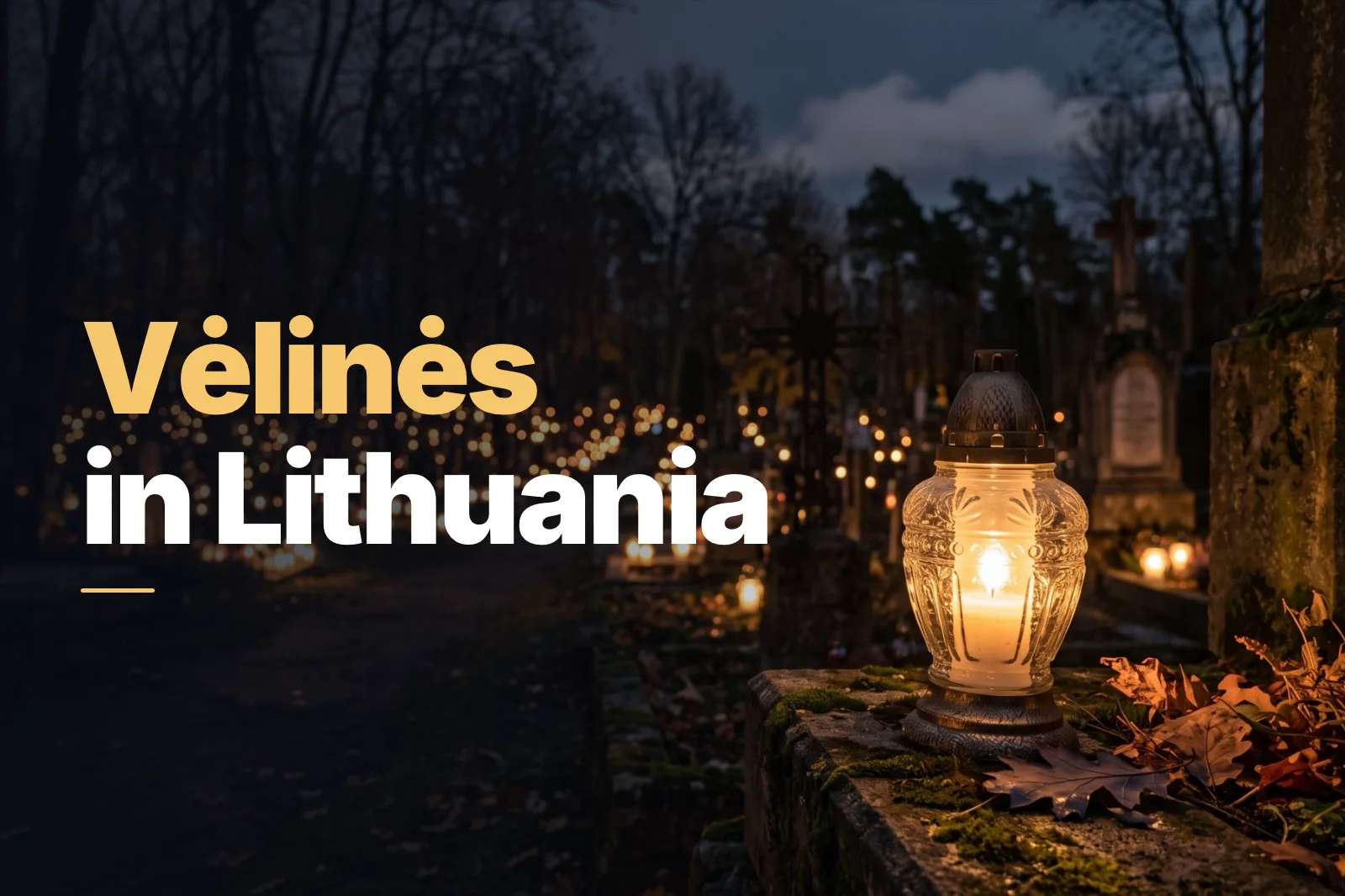
- Candles. In the evening, cemeteries are filled with a sea of candles. They are placed in glass lanterns with lids.
- Chrysanthemums. Along with candles, chrysanthemums (chrizantemos) appear in cemeteries: these are among the few flowers that are not afraid of the first frosts. In Lithuania, it is customary to bring white ones.
- Abandoned graves. More and more often, people visit not only the graves of relatives but also abandoned ones that no one tends to.
- Family dinner. Dinner in the family circle (Vėlinių vakarienė) remains an important part of the day: at the table, the departed are remembered.
- Less plastic. More and more often, people talk about “ecological Vėlinės”: one good candle instead of ten cheap ones, lanterns that are used more than once.
What this means in practice
- Both days are non-working. In 2026, 1 November falls on a Sunday, and 2 November on a Monday, so the weekend runs consecutively from 31 October to 2 November. A holiday that coincides with a weekend is not transferred to another day.
- School holidays. Autumn holidays in 2026 are from 2 to 8 November, classes resume on 9 November. With the weekends, schoolchildren get nine consecutive days off.
- Cemeteries. They are most often visited on 1 November and in the evening, so large cemeteries are crowded at this time. If you are driving, allow extra time.
- How a non-working day differs from a holiday and a commemorative date — in the article about holidays and days off in Lithuania.
Useful holiday glossary
These words will appear on store signs, in conversations, and on signs in late October and early November:
| Lithuanian word | Meaning |
|---|---|
| Vėlinės | Day of Remembrance of the Deceased |
| Vėlė / Vėlės | Soul of a deceased person / souls of the departed |
| Kapinės | Cemetery |
| Kapas | Grave |
| Žvakė / žvakutė | Candle, lantern |
| Ugnis / Šviesa | Fire / light |
| Lapkritis | November (literally: falling leaves) |
| Chrizantemos | Chrysanthemums — traditional autumn flowers of remembrance |
| Ramybė | Peace, tranquility, silence |
| Atmintis / Pagarba | Memory / respect, honor |
Advice for those who are new to Lithuania
If you want to feel the atmosphere, take a walk in the evening of 1 or 2 November through one of the historic cemeteries:
- In Vilnius: Rasų kapinės — one of the oldest and most important cemeteries in the country, the old part founded in 1801; or Bernardinų kapinės in Užupis, on the steep bank of the Vilnia River.
- In Kaunas: Petrašiūnų kapinės.
Candles and lanterns appear in stores in advance. Keep quiet and set a candle by an old cross: this is one of the most sincere ways to connect with the culture of Lithuania.