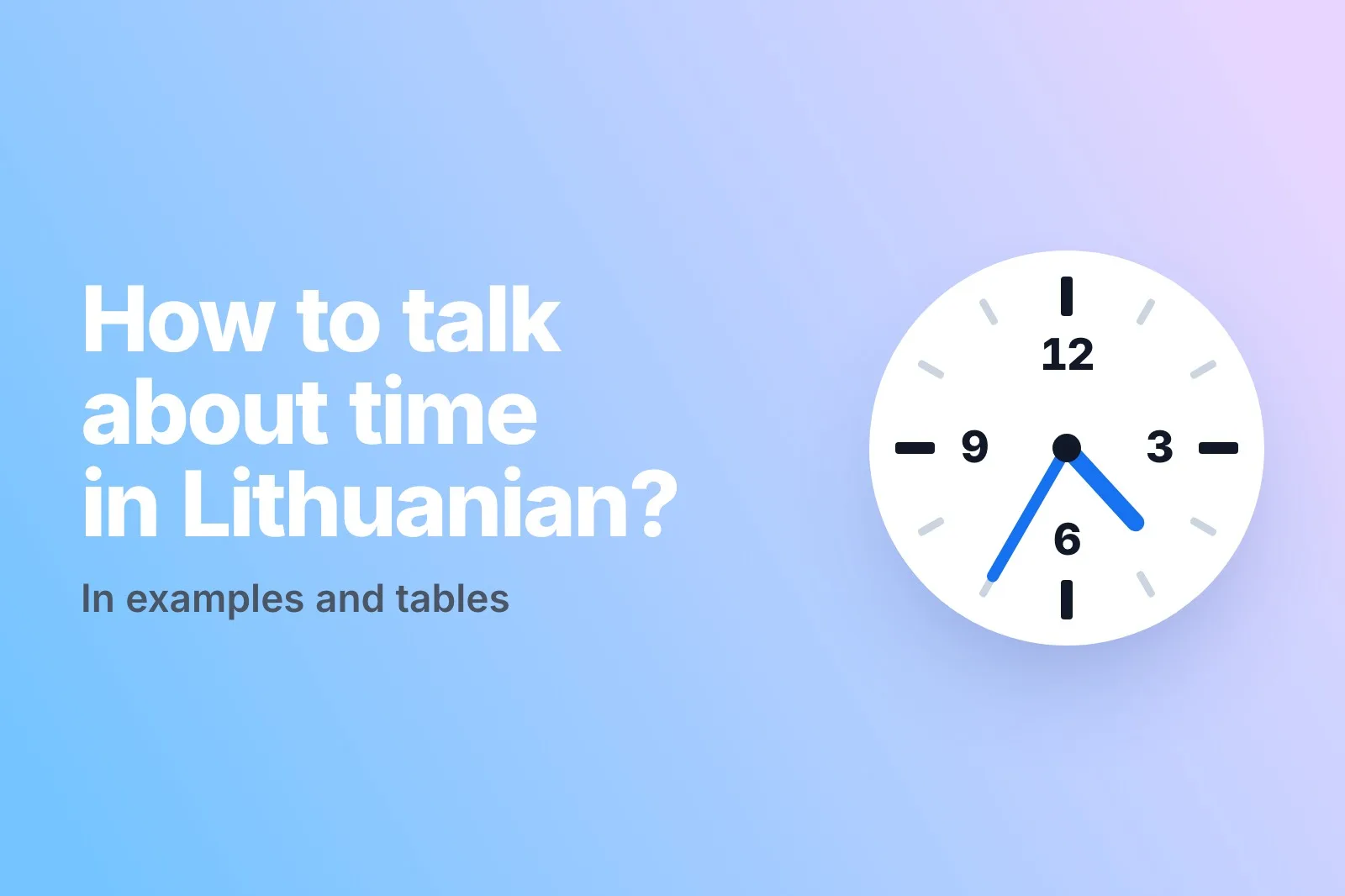
In short: you ask Kiek valandų? or Kelinta valanda? and answer penkta valanda. For “at what time” it becomes penktą valandą. A half hour is counted by the hour still running: 4:30 is pusė penktos or pusė penkių. Both forms are correct and equally common.
How to ask the time
| Lithuanian | Meaning |
|---|---|
| Kiek valandų? | What time is it? (literally “how many hours?”) |
| Kelinta valanda? | What time is it? (literally “which hour?”) Asks about the present moment — what the clock shows now |
| Kelintą valandą? | At what time? Asks about the time of an event: when it starts, when we meet. The difference is the ending -ą |
| Kiek dabar laiko? | What is the time now? |
| Gal galėtumėte pasakyti, kiek dabar valandų? | Could you tell me the time? — polite, to a stranger |
The answer can be very short: Lygiai pirma. — “Exactly one o’clock”. Lygiai means “exactly”.
Full hours: “what time” and “at what time"
Valanda is feminine, so the number with it is feminine too. For “at what time” the written ending becomes -ą, and in speech the stress shifts as well: Keliuosi septintą. — “I get up at seven”. But yes, this is our good old galininkas, the accusative. The word valandą is often dropped.
| Time | What time it is | At what time |
|---|---|---|
| 1:00 | pirma valanda | pirmą valandą |
| 2:00 | antra valanda | antrą valandą |
| 3:00 | trečia valanda | trečią valandą |
| 4:00 | ketvirta valanda | ketvirtą valandą |
| 5:00 | penkta valanda | penktą valandą |
| 6:00 | šešta valanda | šeštą valandą |
| 7:00 | septinta valanda | septintą valandą |
| 8:00 | aštunta valanda | aštuntą valandą |
| 9:00 | devinta valanda | devintą valandą |
| 10:00 | dešimta valanda | dešimtą valandą |
| 11:00 | vienuolikta valanda | vienuoliktą valandą |
| 12:00 | dvylikta valanda · vidurdienis | dvyliktą valandą |
| 0:00 | vidurnaktis |
An ordinal agrees with valanda in full, eleven and twelve included: vienuoliktą valandą, dvyliktą valandą. The form without -ą belongs to cardinal numerals — vienuolika, dvylika — which are a different set.
You can also answer with a cardinal, the way a timetable does: Dabar yra septynios valandos. — “It is seven o’clock now”.
Official time: displays, timetables, radio
Announcements and timetables use the 24-hour scale and cardinal numerals. The written form is 16.30 val. or 16 val. 30 min. A colon also occurs: 16:30.
| Time | Official | In conversation |
|---|---|---|
| 16:00 | šešiolika valandų | ketvirta (valanda) |
| 16:10 | šešiolika valandų dešimt minučių | dešimt (minučių) po ketvirtos |
| 16:30 | šešiolika valandų trisdešimt minučių | pusė penktos |
| 16:50 | šešiolika valandų penkiasdešimt minučių | be dešimt (minučių) penkta |
The half hour: pusė penktos and pusė penkių
The half is counted by the hour that is still running. At 4:30 the hour hand sits between four and five, so the fifth hour is in progress — which is why pusė penktos means 4:30, not 5:30. English works the other way round, counting from the hour just passed: “half past four”.
There are two ways to say it, and both are correct:
- pusė penktos — with an ordinal, “half of the fifth hour”;
- pusė penkių — with a cardinal, “half of five”.
After pusė the number is in the genitive, kilmininkas, in both variants. The only difference is which kind of number it is. For “at what time”: pusę penktos / pusę penkių.
| Time | Ordinal | Cardinal |
|---|---|---|
| 12:30 | pusė pirmoshalf of the first | pusė pirmoshalf of one |
| 1:30 | pusė antroshalf of the second | pusė dviejųhalf of two |
| 2:30 | pusė trečioshalf of the third | pusė trijųhalf of three |
| 3:30 | pusė ketvirtos | pusė keturių |
| 4:30 | pusė penktos | pusė penkių |
| 5:30 | pusė šeštos | pusė šešių |
| 7:30 | pusė aštuntos | pusė aštuonių |
| 9:30 | pusė dešimtos | pusė dešimt |
| 10:30 | pusė vienuoliktos | pusė vienuolikos |
| 11:30 | pusė dvyliktos | pusė dvylikos |
Both forms are equally common, so use whichever sticks, and learn to recognise the other by ear. There is one exception: half past twelve has no cardinal variant — only pusė pirmos.
Minutes: po and be
po is “past”, the first half of the hour. be is “to”, the second. The word minučių can be dropped: be dešimt penkta. Both sets of numerals work here too: dvidešimt penkios po ketvirtos and dvidešimt penkios po keturių.
| Time | Ordinal | Cardinal |
|---|---|---|
| 4:05 | penkios minutės po ketvirtos | penkios minutės po keturių |
| 4:10 | dešimt minučių po ketvirtos | dešimt minučių po keturių |
| 4:15 | penkiolika minučių po ketvirtos | penkiolika minučių po keturių |
| 4:20 | dvidešimt minučių po ketvirtos | dvidešimt minučių po keturių |
| 4:40 | be dvidešimt minučių penkta | be dvidešimt minučių penkios |
| 4:45 | be penkiolikos minučių penkta | be penkiolikos minučių penkios |
| 4:50 | be dešimt minučių penkta | be dešimt minučių penkios |
| 4:55 | be penkių minučių penkta | be penkių minučių penkios |
Watch the number after be: be penkių, be penkiolikos, but be dešimt and be dvidešimt — these two do not change.
For “at what time” after be, the hour takes -ą: Susitinkame be penkiolikos šeštą. — “We are meeting at a quarter to six”.
Quarters
Instead of “fifteen minutes” you will also hear ketvirtis, “a quarter”, the same way pusė replaces “thirty minutes”:
| Time | Lithuanian | Literally |
|---|---|---|
| 1:15 | ketvirtis po pirmos | a quarter past one |
| 2:15 | ketvirtis trečios | a quarter of the third hour |
| 4:15 | ketvirtis penktos | a quarter of the fifth hour |
| 5:45 | be ketvirčio šešios | a quarter to six |
When, from when and until when
| Pattern | Example | Translation |
|---|---|---|
| nuo … iki … (from … to …) | Parduotuvė dirba nuo aštuntos iki dešimtos. | The shop is open from eight to ten. |
| iki … (until) | Mokausi iki antros. | I study until two. |
| apie … (about) | Ateisiu apie ketvirtą valandą. | I will come at about four. |
| po … (in) | Susitinkame po penkiolikos minučių. | We are meeting in fifteen minutes. |
| per … (within) | — Per kiek laiko tu išvirsi sriubą? — Per pusvalandį. | "How long will the soup take you?” — “Half an hour”. |
| for which hour | Prašom duoti bilietą penktai valandai. | A ticket for five o’clock, please. |
Po does two jobs: dešimt minučių po šeštos is “ten past six”, while po dešimt minučių is “in ten minutes”. If “in ten minutes” or “ten minutes later” fits, it is the second one.
The cases behind these prepositions are collected in our guide to Lithuanian cases.
Ready-made dialogues
— Gal galėtumėte pasakyti, kiek dabar valandų?
— Dabar pusė dešimtos.
"Could you tell me the time?” — “It is half past nine”.
— Kelintą valandą susitinkame?
— Septintą.
"At what time are we meeting?” — “At seven”.
— Kada dirba parduotuvė?
— Nuo 8 iki 22 valandos.
"When is the shop open?” — “From 8 to 22”.

and numerals
What to learn first
For the exam, full hours come first: Keliuosi septintą., Pamoka prasideda devintą valandą. Halves, minutes and quarters are what you need to follow live speech, announcements and a person who has their own habitual form. So it helps to recognise both variants and to speak with whichever one you learned first.
Frequently asked questions
Which is correct: pusė penktos or pusė penkių?
Both are, both mean 4:30, and both are equally common. Pusė penktos is the form given in the textbook “Nė dienos be lietuvių kalbos”; pusė penkių is cited by the linguist Kazys Ulvydas and appears in the Lithuanian ministry’s A2 level description.
Does pusė penktos mean 4:30 or 5:30?
4:30. The half is counted by the hour currently running, so “half of the fifth hour” is half past four.
What is the difference between Kiek valandų? and Kelintą valandą?
Kiek valandų? asks what time it is now. Kelintą valandą? asks at what time something happens.
How is time written in Lithuanian?
16.30 val. or 16 val. 30 min., as recommended by the State Commission of the Lithuanian Language. A colon, 16:30, also occurs.
Sources
The forms in these tables were checked against the textbook “Nė dienos be lietuvių kalbos” (2020), the article by the linguist Kazys Ulvydas in the Institute of the Lithuanian Language journal “Bendrinė kalba” No. 93, the A2 level description of the Lithuanian Ministry of Education, Science and Sport, and the State Commission of the Lithuanian Language on writing the time. They were additionally reviewed by our editors, native speakers of Lithuanian.