If you’re learning Lithuanian, you’ve almost certainly seen this table.
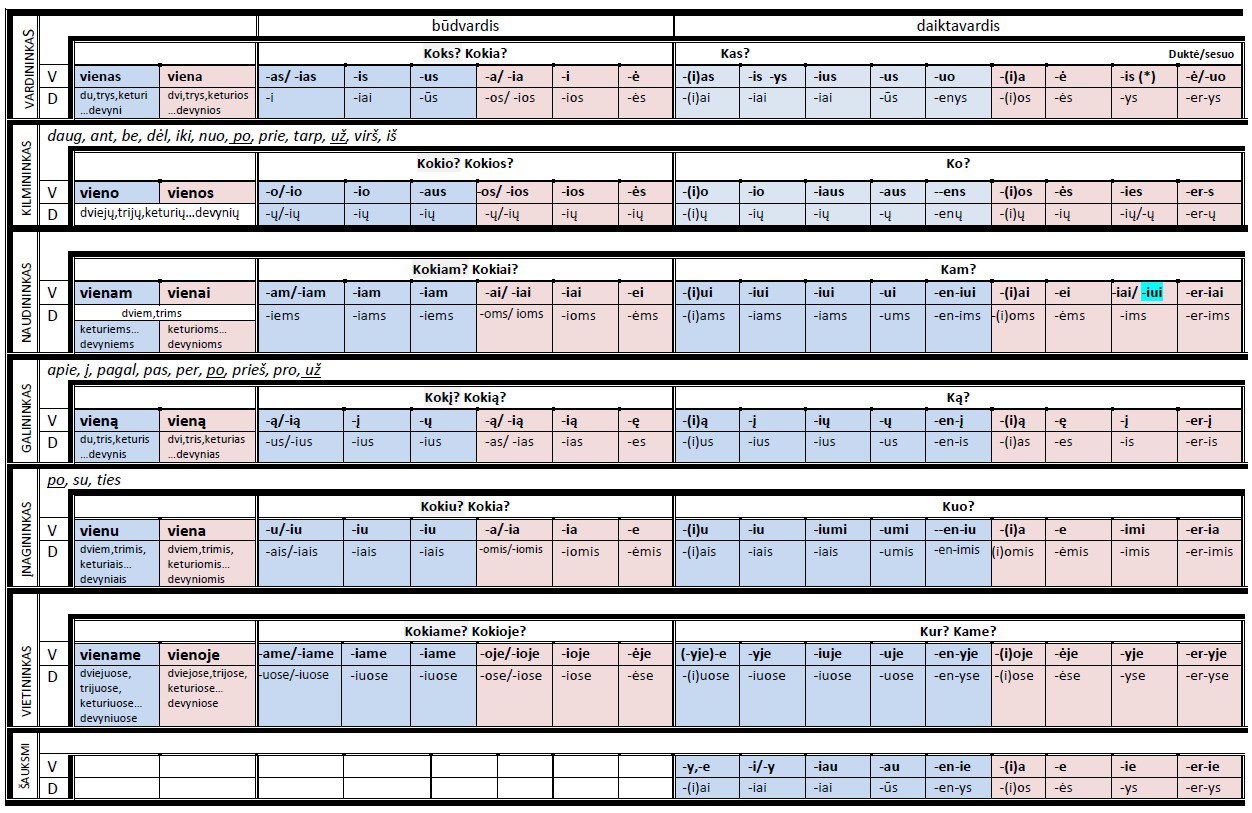
The blue-red case endings table for nouns, adjectives, and numerals is one of the most recognizable Lithuanian grammar references out there. People print it out, save it on their phones, use it in class, and recommend it to each other. For many learners, it has become the go-to cheat sheet for mastering declension endings.
But few people know that this table has an author and a story behind it. Julija, a member of Lietuvių Kalbos Klubas and a former student of the table’s creator, shared this story with us. As Julija put it, she simply wanted everyone to know who is behind the table that thousands of people have been using for years.
The Author — Aušra Pakalkienė
The creator of the famous table is Aušra Pakalkienė, a Lithuanian language teacher based in Vilnius. She previously taught Lithuanian courses at a national minorities school and currently works as a Lithuanian language teacher at A. Pushkin school. She also runs her own Lithuanian language courses — “Aušros lietuvių kalbos kursai".
The table wasn’t created in isolation — it was born through hands-on classroom work with students: during lessons, discussions, and the search for the clearest and most intuitive way to present complex grammar. That’s exactly why it works so well — its format has been refined through real practice.
Why Did This Endings Table Become So Popular?
Clear color coding and a compact structure — that’s what made it truly iconic. The blue and red colors help you instantly navigate the case endings, while the entire declension system fits on a single page.
Today, teachers across Lithuania use this table. You’ll find it in study chats and groups, and nearly every Lithuanian learner has held it in their hands — or at least on their screen.
The table itself is an image, which isn’t always easy to read on a phone. If you need the same endings as text, split by gender and number, they are collected in our guide to Lithuanian cases.