Picture description is one of the tasks in the speaking part of the Lithuanian language exam. You are shown an image and asked to say what is happening in it: who is there, what they are doing, what they are wearing, what is around them. It takes a couple of minutes — and it can decide whether you come out with A2 or A1.
Below: why this is the task to prepare first, which six-step frame covers all of it, and why the terrifying mistake everyone warns you about does not actually exist.
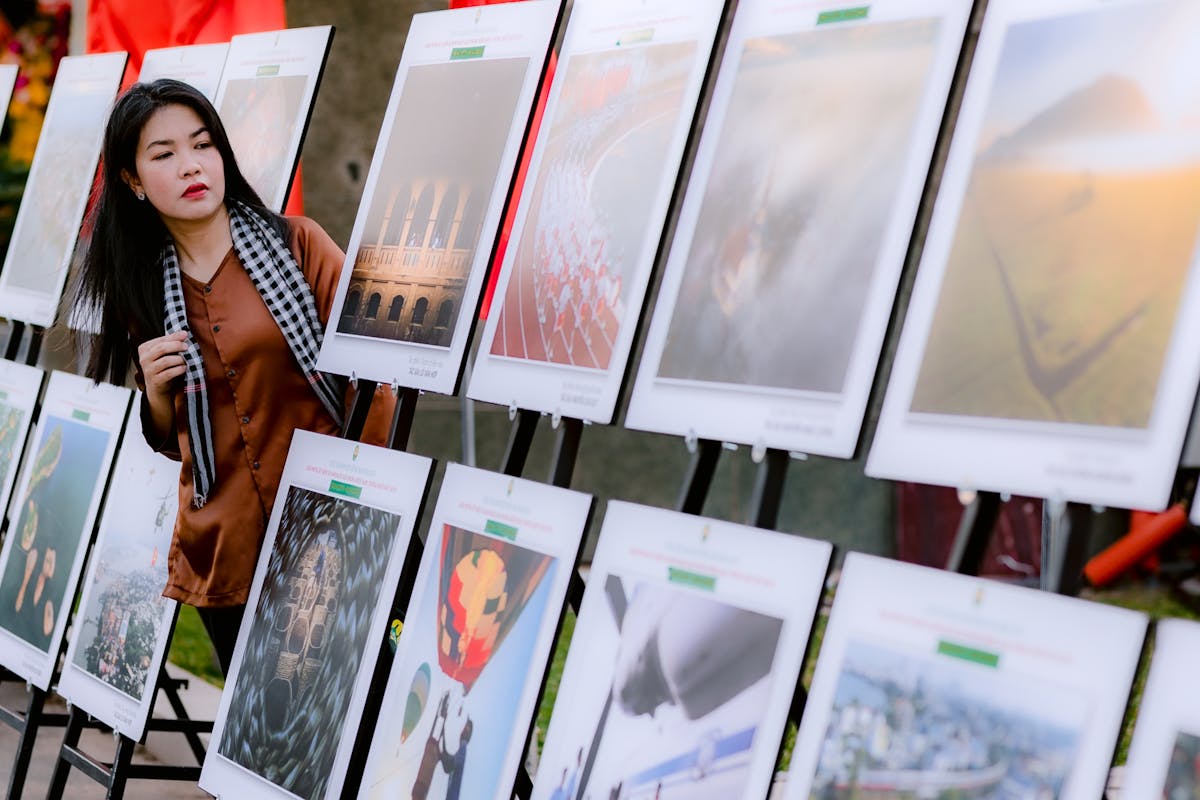 Photo by Nguyễn Tiến Thịnh on Pexels
Where this task sits in the exam
The speaking part is taken in person, with two examiners: one talks to you, the other scores. You get 15 minutes, and the part is worth a maximum of 10 points.
Inside the speaking part there are three situations. Each is worth 0 to 3 points, and the interviewer adds up to 1 more. The picture description is one of those three.
A full walk-through of every part of the exam is in how the A2 exam works. Here we only take the speaking part.
Why this particular task decides the result
It is not just the total that counts. For A1 you need at least 2 points in two situations. For A2, at least two situations together have to give 5 points.
Here are two results with the same total:
- 2 + 2 + 1 plus the interviewer’s point = 6 points → A1
- 3 + 2 + 0 plus the interviewer’s point = 6 points → A2
Same total, different result. So it pays off not to spread yourself evenly, but to push at least one situation to a solid 3.
The picture description is the most predictable of the three. Questions about yourself depend on what you are asked. The announcement depends on which one you get. But a picture is always described by the same scheme, whatever is in it. That scheme can be learned once.
A six-step frame
The examiner needs connected speech, not a list of words. Six sentences are enough, and they always come in the same order.
1. What is in the picture at all.
Šioje nuotraukoje matome didelę šeimą.
In this photo we see a big family.
2. When it is happening.
Yra vasara ir oras labai gražus.
It is summer and the weather is very nice.
3. Where the people are.
Visa šeima ilsisi kieme prie namo.
The whole family is relaxing in the yard near the house.
4. Who is doing what. Two or three sentences here — this is the core of the answer.
Senelis darže sodina gėles.
Grandfather is planting flowers in the garden.
Senelė sėdi ant kėdės ir mezga.
Grandmother is sitting on a chair and knitting.
Berniukas ant žolės žaidžia su dideliu šunimi.
The boy is playing on the grass with a big dog.
5. Details: clothes, colours, objects around.
Mama vilki gražią geltoną suknelę ir dėvi skrybėlaitę.
Mom is wearing a beautiful yellow dress and a hat.
Aplink auga daug gražių gėlių — raudonų, rožinių, geltonų ir baltų.
Many beautiful flowers grow around — red, pink, yellow and white.
6. A short conclusion.
Matome, kad šeimai patinka ryškios spalvos!
You can see that the family loves bright colours!
The content changes, the order does not. If the picture shows a queue in a shop rather than a family in a yard, the first sentence changes and the other five steps stay where they are.
Every Lithuanian sentence above is taken from our own exercises and has been reviewed by native speakers — these are not constructed examples.
The trap that is not there: verbs for wearing
Lithuanian clothing verbs are usually presented as a threat: dėvėti, vilkėti, avėti, mūvėti — supposedly each item has its own verb, and mixing them up is an error.
The State Commission of the Lithuanian Language (VLKK) answers this plainly: nešioti is the general word, a synonym of dėvėti, vilkėti and avėti, and it works not only for clothes but for jewellery too.
More than that, most items allow several verbs, not one:
| Item | What you can say |
|---|---|
| gloves | mūvi, nešioja, dėvi |
| cap, hat | dėvi, nešioja |
| scarf, headscarf | riša, nešioja, dėvi |
| skirt | sega, nešioja, dėvi, vilki |
| trousers, shorts | nešioja, dėvi, vilki |
| shoes | avi, nešioja, dėvi |
| socks | avi, nešioja, dėvi, mūvi |
| rings, bracelets | mūvi, nešioja |
| glasses, contact lenses | nešioja |
The practical takeaway for the exam: when in doubt, use nešioti — it fits everywhere. There is no need to memorise four verbs for the sake of one sentence about clothing.
The case is free too
The second familiar worry is which case to use after these verbs. VLKK’s answer: the accusative and the instrumental are equal variants of the norm here.
- Jis vilki naujais drabužiais — or naujus drabužius.
- Dėvėdamas tuo kostiumu — or tą kostiumą.
- Avėti batais — or avėti batus.
All three pairs are equally correct. There is no way to get this wrong.
Sources: the Consultation Bank of the State Commission of the Lithuanian Language — entries nešioti, semantika, dėvėti, vilkėti kuo, avėti kuo. All of them cite the printed source: Kalbos patarimai. Kn. 2: Sintaksė: 1. Linksnių vartojimas, Vilnius, 2003, p. 73.
How to practise this
The hard part is usually not the words. Individual words are easy to learn — but the exam asks for several sentences in a row, and almost nobody rehearses that out loud in advance.
In the Šaunuolė trainer, picture description is built on the same frame as above. Each picture comes with several ready descriptions reviewed by native speakers. The generator removes some of the words and turns the description into a gap-fill exercise:
- Topic. You choose what to practise — colours, clothes, people, objects around. Those are the words that disappear.
- Difficulty. At the start two or three simple words are removed, and the exercise works almost like reading: you memorise the structure. Later there are more gaps, and what disappears is no longer nouns but verb forms and adjectives in the right case.
The same text therefore gives a different experience: first it is a model, then it is a test.